

Let's be honest: when you're running a trucking operation, the last thing you want to think about is paperwork. But here's the thing: skipping your biennial update isn't just a minor oversight. It can shut down your entire operation and cost you serious money in fines. The good news? Staying compliant is actually pretty straightforward once you understand what you're dealing with.
What Exactly Is a Biennial Update?
A biennial update is your mandatory check-in with the Federal Motor Carrier Safety Administration (FMCSA) every two years. Think of it as renewing your driver's license, but for your trucking business. If you have a USDOT number: and you definitely do if you're hauling freight across state lines: you need to file this update.
The FMCSA uses this information to keep accurate records on every motor carrier and intermodal equipment provider operating in the United States. It helps them track safety performance, ensure regulations are being followed, and maintain up-to-date contact information for all carriers.

Who Needs to File?
If you've got a USDOT number, you're on the hook for this one. That includes:
- Owner-operators
- Small fleet owners
- Large trucking companies
- Intermodal equipment providers
Here's what catches some folks off guard: you need to file even if absolutely nothing has changed with your business. Even if you've stopped operating interstate or closed up shop entirely, the FMCSA still wants to hear from you every two years. No exceptions.
What Information Gets Updated?
Your biennial update covers the nuts and bolts of your operation. You'll need to provide current information about:
- Your company name and physical address
- Total number of vehicles in your fleet
- How many drivers you employ
- Annual mileage your operation covers
- Types of cargo you haul
- Your operating classification
Make sure you've got this information handy before you start the update process. Having everything organized beforehand makes the whole thing go much smoother.
Figuring Out Your Filing Deadline
This is where it gets a little quirky, but stick with me: it's easier than it sounds. Your USDOT number actually tells you when to file.
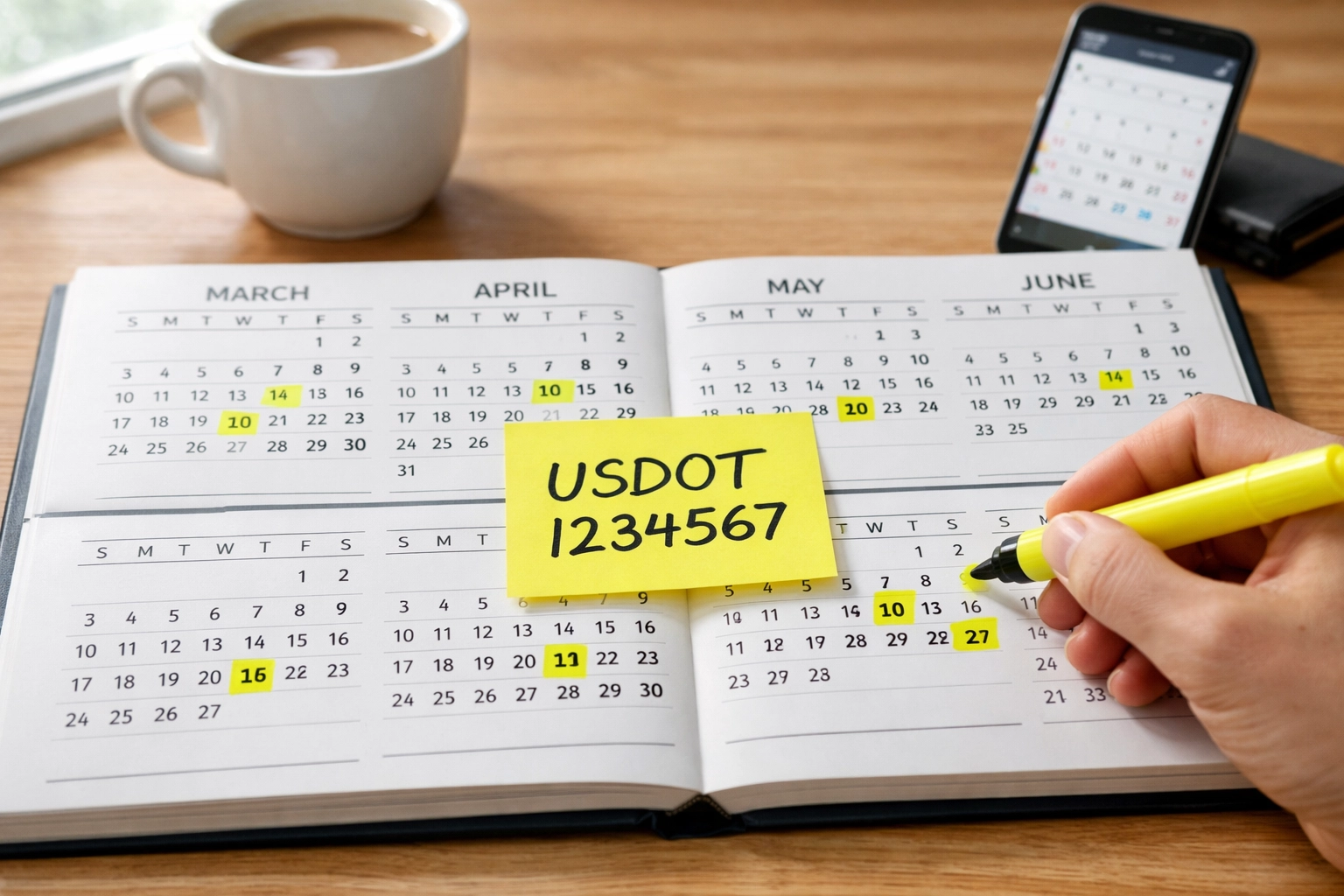
The last digit determines your filing month. If your USDOT number ends in 1, you file in January. Ends in 2? February. And so on through the calendar year. If it ends in 0, you're filing in October.
The second-to-last digit determines which years you file. If that digit is odd (1, 3, 5, 7, 9), you file in odd-numbered years like 2025, 2027, 2029. If it's even (0, 2, 4, 6, 8), you file in even-numbered years like 2026, 2028, 2030.
Let's put this into practice. Say your USDOT number is 123456. The second-to-last digit is 5 (odd), and the last digit is 6. That means you'd file in May of odd-numbered years: so May 2025, May 2027, and so on.
One more example: USDOT number 987640. Second-to-last digit is 4 (even), last digit is 0. You'd file in October of even-numbered years: October 2026, October 2028, etc.
The 12-Month Early Filing Window
Here's a pro tip that can save you stress: you don't have to wait until your deadline month to file. The FMCSA gives you a full 12-month window before your due date.
If you update your MCS-150 or MCS-150C information anytime within those 12 months leading up to your deadline, you're good to go. The system counts that as your biennial update, and you won't get another reminder until your next filing period rolls around two years later.
This is clutch for planning purposes. If you know you've got a slow month coming up, knock out your update early and check it off your list.

How to Actually File Your Update
You've got two options here, but one is clearly better than the other.
Filing Online (The Smart Choice)
The FMCSA strongly recommends: and so do we: filing electronically through their website or the Ask portal. You'll need your USDOT PIN number to access the system. The online process has built-in checks that catch errors before you submit, which means less chance of your update getting rejected or delayed.
The whole thing takes maybe 15-20 minutes if you've got your information ready. Plus, you get immediate confirmation that it went through.
Filing by Mail (The Old-School Route)
You can still mail in your update if you really want to, but honestly, there's no good reason to do this anymore. It takes longer to process, there's more room for error, and you won't get instant confirmation. Save yourself the headache and file online.
Here's something important: this update is completely free. If anyone tries to charge you to file your biennial update, they're running a scam. The FMCSA doesn't charge carriers for this.
What Happens If You Don't File?
Let's talk consequences, because they're no joke.
First, your USDOT number gets deactivated. That means your operating authority is shut down. You legally cannot operate interstate until you get this sorted out. Your trucks might as well be expensive paperweights.
Second, you're looking at civil penalties up to $1,000 per day of non-compliance, with a maximum penalty that can hit $10,000 (adjusted for inflation). That's a lot of money to lose over 20 minutes of paperwork.

Staying On Top of Compliance
Set yourself up for success with these strategies:
Mark Your Calendar Now
As soon as you finish reading this, grab your USDOT number and figure out your filing schedule. Put reminders in your phone or calendar app for three months before your deadline, one month before, and two weeks before.
Keep Your Information Current
Don't wait for your biennial update to fix outdated information. If your address changes, you add trucks, or anything else shifts in your operation, update it right away. This makes your actual biennial update a breeze: you're just confirming everything's still accurate.
Save Your Confirmation
When you file, save that confirmation email or print the confirmation page. Tuck it away somewhere safe. If there's ever a question about whether you filed, you've got proof.
Consider Professional Help
If paperwork and compliance just aren't your thing, there's no shame in getting help. At The Trucker Consultant, we help owner-operators and fleet managers stay on top of all their regulatory requirements, including biennial updates. Sometimes it's worth paying someone to handle this stuff so you can focus on what you do best: moving freight and making money.
The Bottom Line
Your biennial update might seem like just another piece of bureaucratic busywork, but it's a critical part of keeping your operation legal and running smoothly. The actual filing process is quick and free. The penalties for missing it are severe and expensive.
Take 20 minutes every two years to update your information, set yourself good reminders, and you'll never have to worry about this becoming a problem. That's a pretty small investment to protect your business and your livelihood.
Need help figuring out your compliance requirements or want someone to handle the details for you? Reach out to our team: we're here to make sure you stay on the road and out of trouble with the FMCSA.